Some discussions around data architecture and modern data platforms are somewhat over simplistic. For example, if you asked someone to explain the difference between ETL and ELT you might get the following:
“ETL is old, ELT is new”
“ETL is bad, ELT is good”
“ETL is databases, ELT is data lakes”
Let’s actually understand the terms first with the help of the AWS blog, which has a lot of great content.
Firstly, AWS points out that the E (Extract) is the same in both cases – happy days, we can move on.
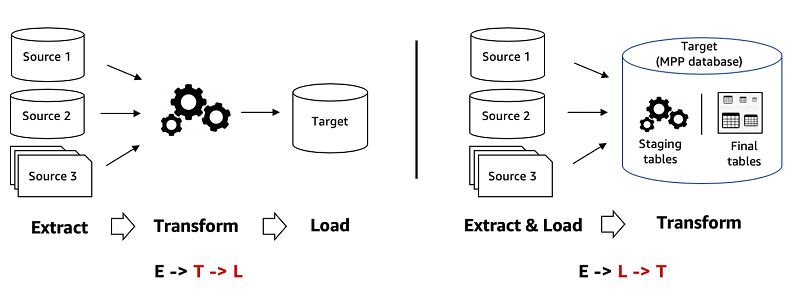
Now, using both the above diagrams and below table we can compare the T (Transform) and L (Load).
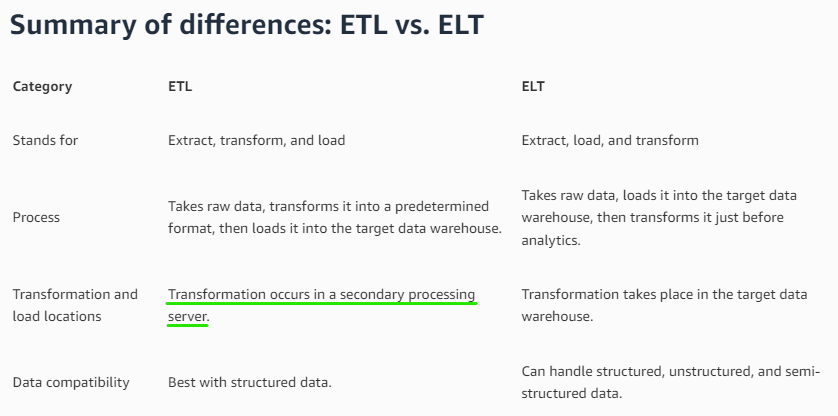
Once I had taken this information in, I started to think back to all the SQL Server based Data Warehouses I have worked on over the last 15 years or so.
I started to realise those architectures followed the second image; SSIS would copy (Extract & Load) the source system data “as is” to a staging database on the Data Warehouse server, and we would use Stored Procedures to transform that data into dimensions and facts.
It is entirely possible that some people used SSIS (or other ETL tools) and transformed the data mid-flight and loaded it directly into their star schema, but these were rare as Stored Procedures were often simpler, faster and more elegant.
So although the ELT in the world of Fivetran, semi-structured data and Spark may look quite different to what we were doing ‘back in the day’, if you look at the “dictionary definitions” of the terms, you will see that often, it’s not a fundamental departure from where we were.



 Ben Brown